More Tripe from Papa Frank’s (Un)official PR Team

Mastro_Titta

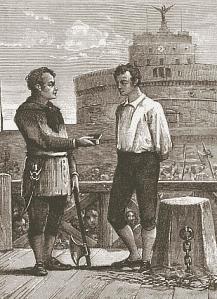
(Picture: Giovanni Battista Bugatti: chief executioner for the Papal States during the 19th century).

Fr. Dwight Longnecker is one of those fellows who started out evangelical, jumped ship for Anglicanism, and then swam the Tiber. He regularly spouts off Roman propaganda that flies in the face of historic fact and whitewashes the messiness of his own church and gives a false impression of the piety and holiness of his revered institution. Not surprisingly, Longnecker defends his pope’s politics against left and right because, you know, Francis just sat down in the middle of the road and we know the only thing you find there is roadkill (fellow wardog Clearly Mad pointed out yesterday). But the pope is Christ on earth for over a billion Catholics (no small amount of influence there), so when his holiness spouts off silly things, of course Longnecker must follow him into the breach of sophomoric claims about history, politics, and justice. 

So it’s of little surprise that Longnecker stuck his neck out too far at Patheos the other day.

Continue reading

Zinn’s Oppressor and Oppressed Exposed to be One in the Same

At the beginning of summer I picked up David Halberstam’s The Fifties. Halberstam, winner of the Pulitzer Prize in 1964 for his journalism in Vietnam, put his research skills to work during the next four decades of his life writing books on history. The Fifties puts his talents on display as he effortlessly and colorfully takes us on a fantastic trip through one of America’s most storied decades. It’s a joy to read a work that is not only well-researched but well-written.

One thing about good history is that it has a tendency to surprise you. When a writer inhabits the past fully, leaving behind his 21st century prejudices, unique and unexpected things begin to pop out of the woodwork. One particular historical nugget caught my eye in Halberstam’s work: his account of Earl Warren. And then I thought of my whipping boy, Howard Zinn, and couldn’t resist taking him to task yet again.

Continue reading

The New Atheists (Mis)Use of History (Stupid or Sinister?)

Those in the West tend to favor the pronouncements of scientists too much. While works on theology written by scientists (e.g Dawkins, The God Delusion) are praised despite their theological vacuity, there is a general skepticism about non-scientists making any sort of claim on science that diverge from the scientific mainstream. This double-standard that privileges the scientist also permits that profession to write “reputable” histories as well; for example, the scientist Jared Diamond’s Guns, Germs, and Steel is widely acclaimed (by Bill Gates no less!) despite the fact that its thesis is historically dubious. This is not merely a science vs. theology issue. The conflict runs deeper:  science has accrued such a bloated reputation that people too often thoughtlessly embrace books, articles, and shows merely because they feature a man with a Ph.D. in biology. Little else can explain the popularity of the New Atheists. They are scientists, so we must give them credence, even when they begin speaking to matters out of their field of study. This is an intellectual state of affairs that bodes poorly for culture at large. The minute one sort of knowledge begins to trump all others you get a myopic view that blinds more than it enlightens. (The writer would also like to point out that such a critique is equally applicable to religious fundamentalists).

The West’s embrace of science has led to the inability to identify the sketchiness of the New Atheists’  historical rhetoric (among other things), which is something I intend to explore here by considering their metahistory (a grand theory of history and where it’s going) and then a specific example of Christopher Hitchens’ specious historical rhetoric in support of that metahistory.

Continue reading